Guerin® Blog
Driving Advice
Reflective vests in the car: what are they for and how should you wear them?
Share


If your car becomes immobilised and you need to get out to place the warning triangle, repair the vehicle or remove a load from the road, there is one rule you should not leave until later: put on your reflective vest while you are still inside the car. On a highway or expressway, where other vehicles are travelling at high speeds, getting out first and looking for the vest afterwards is an unnecessary risk.
In Portugal, the fine for not carrying a high-visibility vest ranges from €60 to €300 for each mandatory item missing. The same fine may apply if the vehicle does not have a reflective vest that meets the legal requirements.
Wearing a high-visibility vest is also mandatory for anyone placing the warning triangle, repairing or removing a vehicle that has broken down on the road, or clearing fallen cargo from the road.
Failure to comply with these rules may result in a fine ranging from €120 to €600, in accordance with Article 88 of the Portuguese Highway Code.
What is a reflective vest for?
A reflective vest makes it easier for other drivers to see a person standing near the road. This increased visibility is particularly important when a vehicle becomes immobilised on a motorway, expressway or in an area with poor visibility, whether at night, in rain or in fog.
More than just a legal requirement, it is a piece of safety equipment designed to reduce the risk of being hit by a vehicle when someone needs to get out of the car in an emergency.
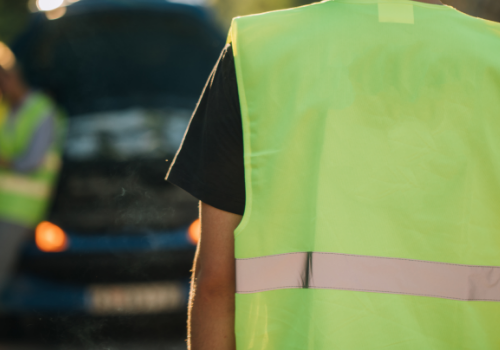
Who should wear the reflective vest?
It does not necessarily have to be the driver. The law refers to the person carrying out the operation. This means that if a passenger is placing the warning triangle or helping to remove the vehicle or its load, that person must wear the reflective vest.
The law requires an approved reflective vest to be present in the vehicle, not one vest per occupant. Even so, anyone who regularly travels with several passengers may choose to carry more than one as an additional safety measure.
Where should you keep the reflective vest in the car?

Where should you keep the reflective vest in the car?
The law does not specify a particular compartment where the reflective vest must be stored. However, it should be kept somewhere that is easily accessible from inside the vehicle. The glove compartment, a door pocket or a storage pocket next to the seat are practical options.
Keeping the vest in the boot is not recommended. On a motorway or expressway, this would mean having to leave the car before putting on the equipment designed to make you more visible.
So, choose a location where you can reach and put on the reflective vest without leaving the car.
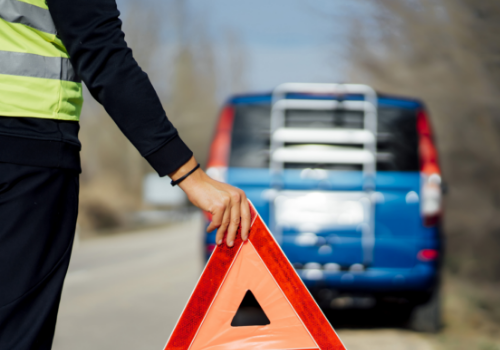
Should you put on the reflective vest or place the warning triangle first?
The two pieces of equipment have different but complementary purposes. First, put on the reflective vest before carrying out any operations outside the vehicle. Then place the warning triangle.
According to the Highway Code, the triangle must be positioned at least 30 metres behind the vehicle or load and in a location where it can be seen from a minimum distance of 100 metres. On bends, hills or in areas with reduced visibility, this last requirement becomes particularly important.
So, remember this sequence:
- Reflective vest.
- Exit the vehicle safely.
- Warning triangle at least 30 metres away and visible from 100 metres.
What colours can a reflective vest be?
Fluorescent yellow is the most common colour, but it is not the only option.
Approved reflective vests are available in different high-visibility colours, including yellow, orange, green and pink. What matters most is not the colour itself, but ensuring that the product complies with the applicable standards and displays the appropriate conformity marking.
To check whether a vest is suitable, inspect the product label and documentation. Look for the applicable standard, the CE marking and, where available, the EU Declaration of Conformity or the relevant certificate. The CE marking indicates that the manufacturer declares the equipment complies with the applicable European requirements, but it should not, on its own, be confused with specific approval for road use.
It is also important not to assume that any fluorescent vest is suitable: the colour, retroreflective material and other characteristics must meet the applicable requirements. If in doubt, choose a vest marketed as road safety equipment that complies with Portuguese legislation, and check the information provided by the manufacturer.
How much does a reflective vest cost?
An approved reflective vest is relatively inexpensive. In Portugal, basic models can be found for approximately €5 to €10, although the price varies depending on the brand, size and retailer.
For use in a private car, a simple and properly approved model should generally be sufficient. If you are driving a rental vehicle, you should not need to buy one specifically for your trip.
Do rental cars have a reflective vest?
Guerin vehicles include a reflective vest and warning triangle as standard safety equipment.
Even so, when collecting the vehicle, check where they are stored. Knowing where to find this equipment in advance means you will not have to look for it during an emergency.
Before starting your journey, you can also check the rental conditions and book your car with Guerin.
What should you do in the event of a breakdown?
If your car breaks down, start by moving it to the safest possible location and switching on the hazard warning lights.
Before getting out, assess the traffic conditions. If you need to place the warning triangle or carry out any operation next to the vehicle, put on the reflective vest first.
When driving a rental vehicle, do not try to deal with a breakdown yourself if the conditions are unsafe. With Guerin's Premium Road Assistance, you can count on support in situations such as a flat tyre, dead battery, lost key or the need for towing.

Rent your car through a 100% digital process
Preparing for a trip also means reducing complications before you even get on the road.
With Guerin's 100% digital process, you can manage the different stages of your rental independently, from booking and check-in to returning the vehicle, using the website, kiosks and digital solutions provided by the brand.
Guerin tip: before your next trip, book your car and choose the complementary products that allow you to drive with greater peace of mind. Premium Road Assistance provides support in unexpected situations such as a breakdown or flat tyre, while Glass and Wheel Protection provides additional protection in the event of certain damage to windows, tyres, rims, mirrors, headlights and light units. This way, you will be better prepared to deal with unexpected situations and continue your journey.
Share