Guerin® Blog
Rental Guide
Car seat rules in Portugal: choosing and fitting the right seat
Share


Travelling with children calls for extra planning, but few choices matter more than the child car seat. Whether you are flying into Portugal and collecting a hire car, visiting from another European country, or living here after moving from somewhere with different rules, Portuguese law applies as soon as you drive on Portuguese roads.
In Portugal, children under 12 years old who are shorter than 135 cm must travel in an approved child restraint suited to their height and weight. This applies to residents and visitors, in a private vehicle or a hire car, and even on short journeys. Once a child is no longer covered by this specific requirement, the seat belt must still be worn.
Planning a family road trip? Knowing which seat to choose, where to fit it and how to check it before leaving the collection point can make every kilometre calmer and safer.
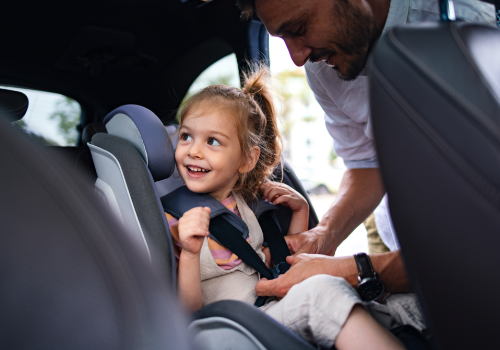
When is a child car seat compulsory in Portugal?
Portuguese law uses both age and height. A child must use an approved restraint when they are under 12 and shorter than 135 cm.
For example, a child aged five who is 110 cm tall must travel in a seat suitable for their size. A child aged eleven who is 136 cm tall is no longer covered by this specific child restraint requirement, although the adult seat belt remains compulsory.
The same rule applies whether the drive to the beach takes five minutes or you are travelling across the country. Visitors and expats should not assume that the age limit or type of seat used in their home country will automatically meet Portuguese requirements. Check the approval label, the permitted height and weight range, and the fitting instructions before you travel.
What happens if a child travels without the correct seat?
The driver is responsible for ensuring that every child uses the required restraint. Carrying a child without the correct approved seat is classed as a serious road offence in Portugal and can lead to a fine of €120 to €600 for each child who is not properly restrained.
A driving ban may also apply. Where the Portuguese points system applies, the offence can lead to the loss of two points for each child, up to six points in the same incident.
Where should the child car seat be fitted?
As a general rule, children covered by the legal requirement must travel in the rear seats.
A child under three may travel in the front passenger seat only in a restraint facing the rear, and only when the passenger airbag is switched off. A child aged three or over may travel in front when the vehicle has no rear seats or when the rear seats have no seat belts. Cars without seat belts may not carry children under three.
When hiring a car, check the seating layout, airbag controls and available space before setting off, especially when you need to fit more than one child seat.
Which child car seat should you choose?
You may still come across seats carrying the older R44 approval label. However, when choosing or hiring a child car seat in Portugal today, the standard to look for is UN Regulation No. 129, known as R129.
R129 uses the child’s height as the main reference, together with any maximum weight stated by the manufacturer. It also includes side impact testing and requires children to travel rear facing until they are at least 15 months old.
Some R129 seats carry the i Size mark. This identifies a category designed to make it easier to match the child seat with a compatible seating position in the vehicle. Not every R129 seat is i Size, so always check the seat instructions and the vehicle manual before fitting it.
Age should be treated only as a general guide. Choose the seat according to the height and weight limits shown on its approval label, and move to the next stage only when the child reaches the limits set by the manufacturer.
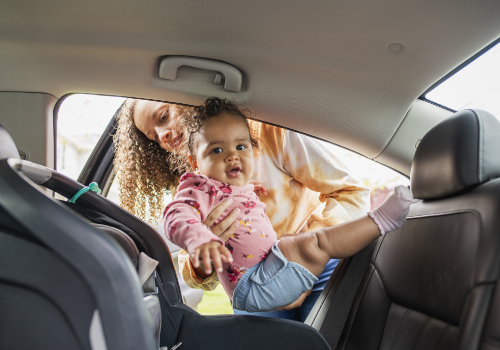
What should visitors and expats check?
Before using a seat brought from another country, confirm that it carries an approval label accepted in Portugal. A seat that is lawful in your home country is not automatically the right choice here, particularly when it was approved under a different technical system. On seats approved under European rules, the label normally includes an E approval mark, the regulation number and the permitted size range.
Check these points before the journey:
- The child’s current height and weight.
- The seat approval and permitted size range.
- Whether the seat is approved for use facing the rear or the front at the child’s size.
- Whether it is compatible with the vehicle.
- Whether every required component, including a support leg or top tether, is present and correctly fitted.
- Whether the seat has been involved in a collision or has visible damage.
Is ISOFIX compulsory?
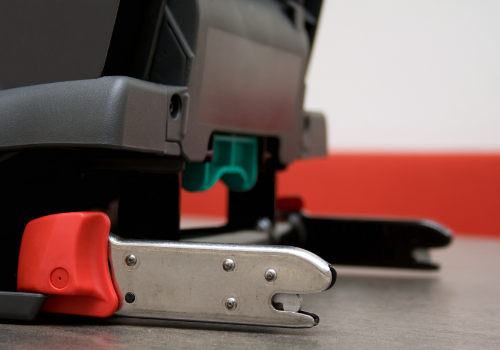
ISOFIX is a standard fitting system that connects a child seat to metal anchorage points built into the vehicle. It can make fitting more straightforward because the seat clips directly into the car rather than relying only on the vehicle belt.
ISOFIX is not automatically compulsory for every child seat. Depending on the seat and the vehicle, the restraint may use ISOFIX, the vehicle seat belt, or a combination of fittings. Some seats also require a top tether or support leg. Always follow the child seat instructions and the vehicle manual.
To check whether a hire car has ISOFIX, look for the ISOFIX symbol or small labels between the seat base and the backrest of the rear seats. The anchor points are usually just inside this gap.
Common mistakes and what to check when fitting a child car seat
Even a good seat cannot protect a child properly if it is fitted incorrectly. Before every journey, make a careful check:
- The seat matches the child’s height and weight.
- The seat is compatible with the vehicle and fitted in an approved position.
- The passenger airbag is off when a seat facing the rear is used in front.
- The vehicle belt follows the correct route and is not twisted.
- The harness is close to the child’s body without excessive slack.
- The ISOFIX connectors are fully locked, where applicable.
- The top tether or support leg is fitted correctly, where required.
- The seat is firm and does not move excessively at the attachment point.
- Every part remains within the limits stated by the manufacturer.
When collecting a hire car, complete this check before leaving the station. Do not wait until the first stop to discover that the seat does not fit the car or the child.
Should you bring your own seat or hire one in Portugal?
Both options can work, but the right choice depends on how you are travelling and how familiar you are with European approval labels.
Bringing your own child car seat
The main advantage is familiarity. You know the seat’s history, your child is used to it, and you already understand how to adjust it.
The disadvantages are practical. A child seat is bulky to carry through an airport, it may be damaged in airline handling, and it may not be compatible with the hire car. A seat approved under a system used outside Europe may also require additional checks before it can be used legally in Portugal.
Hiring a child car seat with Guerin
For most families arriving by air, adding a seat to the car booking is the more convenient option. Guerin offers Baby Seat options in different groups, including seats for infants, toddlers and older children who need a booster. Choose the correct option when booking, using the child’s height and weight rather than age alone.
Confirm availability in advance and check the seat before leaving the station. The exact model may differ from the one your child uses at home, so allow time to read the label, adjust the harness and fit the seat correctly. Make sure all parts are present and that the approved limits match your child. If the seat is unsuitable for the child or the vehicle, do not set off until a suitable replacement is available.
Space matters too. Guerin’s fleet includes roomy options with enough width and easy access for one or two child seats without compromising the comfort of the other passengers. This is particularly important when travelling with luggage, a pushchair and everything else a family journey requires.
Travelling from Portugal to another European country with children
The basic safety principle is shared across the European Union: children must use an appropriate restraint. The technical approval rules for seats are also widely harmonised. However, road traffic laws are not identical in every country. Age limits, height limits, front seat rules and booster requirements can vary, so check the rules for every country you plan to visit or cross.
Before a European road trip with children:
- Check the child restraint rules for every country on the route.
- Keep the seat label and fitting instructions available.
- Confirm that the seat remains suitable throughout the journey.
- Plan regular stops so that the driver and children can rest.
- Never change the seat position or restraint while the vehicle is moving.
Families taking a Guerin vehicle outside Portugal must add the Cross Border product and travel only in countries authorised under the rental conditions. Check the current country list before departure, as authorisation and contract requirements must be arranged in advance.
Make long family journeys easier
Travelling with children can be tiring. Frequent stops, crying and the need to monitor younger passengers can increase driver fatigue and distraction.
Adding an Additional Driver allows another authorised adult to share the driving. Every person who may drive must be registered on the rental agreement and present the required documents when the vehicle is collected.
A breakdown in an unfamiliar country is particularly stressful when babies or young children are on board. Guerin’s Premium Road Assistance can remove towing or roadside assistance costs in a range of common situations and provides support in Portugal and abroad.
With the correct child seat, enough room for the whole family, the option to share the driving and suitable road assistance, all that remains is to enjoy the journey with more comfort and, above all, greater safety.

Share