Guerin® Blog
Driving Advice
Traffic signs in Portugal: what confuses drivers, what they forget and what it costs
Share


If you drive in the EU, you will recognize almost every sign on a Portuguese road. Portugal follows the European system, so the shapes, colors and pictograms are the ones you already know.
What catches people out is not the signs. It is the rules behind them: the blood alcohol limit, the speed limits for each road type, how long a speed limit stays in force, the green "Via Verde” lane at toll gates and the two near identical parking signs.
This article covers the differences that matter, the equipment your car must carry by law and what the fines actually cost.
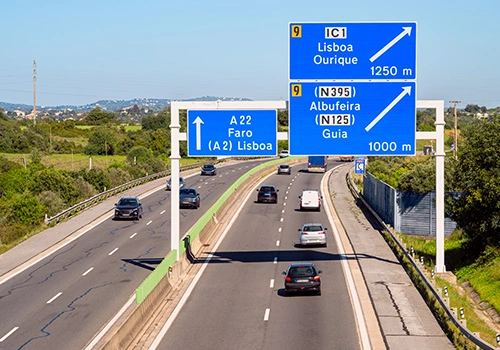
Which driving rules differ from other European countries?
What is the blood alcohol limit in Portugal?
The limit is 0.5 g/l for most drivers, lower than the 0.8 g/l that applies in England and Wales. It drops to 0.2 g/l for professional drivers and for anyone in their first three years of holding a license. From 1.2 g/l, it stops being an administrative offense and becomes a criminal one.
Refusing a breath test is a separate criminal offense and is treated at least as seriously as a positive result.
What are the speed limits in Portugal?
Where no sign says otherwise, the general limits for a standard car are:
- 50 km/h in built-up areas
- 90 km/h on other public roads
- 100 km/h on roads reserved for cars and motorcycles
- 120 km/h on highways
Highways also have a minimum: you may not drive below 50 km/h unless traffic conditions require it. Doing so carries a fine of between 60 and 300 euros.
One rule surprises almost everyone. A maximum speed sign stays in force until it is canceled by an end of restriction sign or by a sign marking the start of a road with a different limit. It does not expire after a few hundred meters and it does not reset at a roundabout.
Variable message panels, the dark boards with illuminated characters, override the fixed signs. If the gantry reads 80, the limit on that stretch is 80 and not 120.
What safety equipment must the car carry?
Every car on a Portuguese road must carry an approved reflective vest and an approved warning triangle. Both are compulsory under article 88 of the Highway Code, and both are already on board every Guerin car.
The order in which you use them is where drivers get fined. If you break down or stop on the roadway, you put the vest on inside the car, before opening the door. Only then do you place the triangle, at least 30 meters behind the vehicle and visible from 100 meters away.
Not carrying the equipment costs 60 to 300 euros. Not wearing the vest, or placing the triangle incorrectly, costs 120 to 600 euros. Failing on both counts means two separate charges.
None of this helps if the equipment is not in the car, and in a rental car it is rarely checked before you set off. Every Guerin car leaves the branch with an approved vest and triangle on board. Check-in is done online and the pickup takes just a few minutes. At the airports, collecting and returning the car without going to a counter is how it already works.
Which traffic signs confuse visitors most?
What is the green "Via Verde” lane at a toll gate?
"Via Verde” is Portugal’s electronic tolling system. The green lanes marked with a white V are reserved for vehicles carrying a registered transponder. Entering one without a device means you cannot pay and it is a common and expensive mistake on the way out of the airport.
Portugal also has fully electronic highways with no barriers at all, where a camera reads the license plate and there is nowhere to stop and pay. The Toll Service included with Guerin rentals covers both cases: you drive through and the tolls are settled on your rental account.
No parking or no stopping? Two signs, one small difference
Both are round, blue, with a red border. A single diagonal bar means no parking: you may stop briefly, with the driver in the car, to let someone in or out. Two crossed bars mean no stopping and no parking: you may not bring the car to a halt at all.
The same logic applies to the yellow lines painted along the curb. Continuous yellow means no stopping and no parking. Broken yellow means no parking, but stopping is allowed.
The base fine runs from 30 to 150 euros. It rises to 60 to 300 euros on a crosswalk or a sidewalk, where it blocks people on foot.
Yield or stop?
The inverted triangle means yield: if the road is clear, you may continue without stopping. The octagonal STOP sign requires a complete halt, even with nothing in sight.
At a roundabout, the entry rule is simple: traffic already on the ring has priority, whichever lane it is using. Drivers entering give way.
The confusion is about lane choice and it is set out in article 14-A of the "Highway Code”. To take the first exit, stay in the right hand lane from the start. To take a later exit, use an inner lane and move right only after passing the exit immediately before the one you want.
The most common mistake is moving right too early, or too late and all at once, crossing two lanes on top of the exit. Signal the maneuver and check your blind spot before changing lanes. Getting it wrong carries a fine of 60 to 300 euros.
How much do traffic fines cost in Portugal?
Offenses are graded as minor, serious or very serious and the fine follows the grade.
Speeding is banded. Up to 20 km/h over the limit in a built-up area, or 30 km/h outside one, costs 60 to 300 euros. The next band costs 120 to 600 euros and counts as a serious offense. Above that, 300 to 1500 euros. And in the most extreme cases 500 to 2500 euros.
Simply holding the phone is enough, whether to write a message, read a notification or check the map while the car is moving. All of it falls under the same rule. Hands free systems, a single earpiece and a phone in a fixed mount are allowed, provided the route is set before you move off.
The fine runs from 250 to 1250 euros.
What is changing in the Highway Code?
In April 2026, the Portuguese government announced a new Código da Estrada that will bring together the various pieces of legislation approved over recent decades. A working group has been set up to put forward proposals, with the intention of bringing the new code into force during 2026. The plan also includes reactivating the GNR traffic division, disbanded in 2009 and installing new average speed cameras.
Guerin tip: what to check before a long drive?
Check the speed limits and any traffic restrictions along your route before you leave, particularly during roadworks or major events, and remember to set your route with the car stopped.
Two decisions are made at booking, not on the road. Damage protection with a reduced excess is worth considering if you will be driving in historic city centers, where streets are narrow and parking is tight. And an Additional Driver lets you share long stretches at the wheel, since fatigue remains one of the most frequent risk factors on Portuguese roads.

Share