Guerin® Blog
Driving Advice
The ultimate guide to safe driving in roundabouts in Portugal
Share


Few features of the road network cause as many questions for drivers as roundabouts. For anyone driving in Portugal for the first time, whether a tourist, expat or local driver, choosing the right lane, knowing who has priority and understanding when to indicate can be particularly challenging.
The good news is that the rules don't have to be complicated. In this guide, we explain how to drive around roundabouts in Portugal, from entering and choosing the right lane to taking the correct exit, including the rules for multi-lane roundabouts, the most common mistakes and the precautions that can make driving safer.
What is a roundabout and what is it used for?
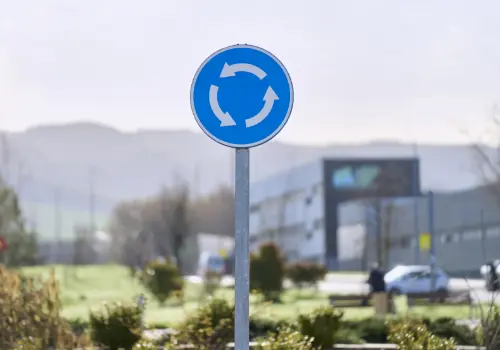
A roundabout is a road intersection where vehicles travel around a central island. In Portugal, traffic moves around roundabouts in a counter-clockwise direction.
Their purpose is to organise different traffic flows, allowing vehicles to change direction or choose different exits without directly crossing the path of other vehicles.
Compared with some intersections controlled by traffic lights, roundabouts can offer advantages such as lower speeds and lower impact speeds in the event of a collision, as well as smoother traffic flow when traffic volumes are low or moderate.
However, these benefits depend on drivers knowing and following the rules.
What does Portuguese road law say about roundabouts?
In Portugal, there is one fundamental rule: drivers entering a roundabout must give way to vehicles already circulating on it, regardless of which lane those vehicles are using.
The Portuguese Highway Code also establishes rules for lane selection. In simple terms, if you intend to take the first exit, you should use the right-hand lane. If you intend to take a later exit, you should use the lane most appropriate for your destination and, after passing the exit immediately before the one you intend to take, progressively move towards the right-hand lane, always taking the necessary precautions.
Your speed should always be appropriate to the characteristics of the roundabout, road conditions, traffic and visibility. Drivers should be particularly cautious when approaching and circulating around a roundabout.
Certain manoeuvres are also prohibited. Reversing is not permitted on roundabouts, for example. U-turns are also subject to the restrictions and prohibitions established by the Portuguese Highway Code.
And there is one rule that applies in every situation: always follow the road signs and markings in place.
How should you enter a roundabout correctly?
Entering a roundabout is, above all, about anticipating what is ahead.
1. Slow down.
Approach the roundabout at a speed that allows you to observe the traffic and make a decision without rushing.
2. Check the signs.
Before choosing your lane, check the layout of the roundabout and any road signs or lane markings.
3. Give way.
Vehicles already circulating on the roundabout have priority over vehicles entering it.
4. Choose the appropriate lane.
Take into account the exit you intend to use and the layout of the roundabout.
5. Enter only when it is safe.
Do not force your way into the roundabout or make another driver brake or change direction suddenly.
The golden rule is simple: slow down, observe, give way and only then enter.
How should you drive around a roundabout?
On a single-lane roundabout, driving is relatively straightforward: maintain a safe trajectory, remain aware of other vehicles and indicate in good time before taking your exit.
Multi-lane roundabouts require greater attention.
If you intend to take the first exit, you should use the right-hand lane.
If you intend to take a later exit, you should choose the lane most appropriate for your destination. After passing the exit immediately before the one you intend to take, you should progressively move towards the right-hand lane.
This means that you should not cross several lanes at once to reach your exit. Before changing lanes, check your mirrors and blind spots and indicate your intention clearly.
If you cannot move safely into the right-hand lane, do not force the manoeuvre. Continue around the roundabout and look for a safe opportunity to take the exit.
What about large, multi-lane roundabouts?
Large roundabouts can seem more complicated, but the principle remains the same: anticipation is the best way to avoid mistakes.
Before entering, try to identify which exit you need to take. If you are using GPS, this information becomes much easier to anticipate.
While driving around the roundabout, keep a predictable trajectory and change lanes progressively. Avoid sudden movements and never cross several lanes at once.
If you realise that you have missed your exit, don't panic. Continue around the roundabout and follow an alternative route suggested by your GPS.
Who has priority on a roundabout?
The answer is clear: vehicles already on the roundabout have priority over vehicles entering it.
Before entering, you must therefore give way to vehicles already circulating on the roundabout. This rule applies even when those vehicles are travelling in a different lane from the one you intend to use.
Having priority, however, does not mean that you should stop paying attention to other road users. Defensive driving remains important throughout the entire manoeuvre.
What types of roundabouts are there in Portugal?
Portugal has a wide variety of roundabout layouts, ranging from mini-roundabouts, which are common in urban areas, to large roundabouts with two or more lanes and multiple exits.
Their size and configuration can vary considerably. Rather than memorising a single approach, it is more important to understand how to read the signs and adapt your driving to the characteristics of each roundabout.
The most common mistakes on roundabouts
Some driving behaviours are particularly common:
- Failing to give way to vehicles already on the roundabout;
- Entering at excessive speed;
- Choosing the wrong lane;
- Failing to use indicators;
- Changing lanes abruptly;
- Stopping unnecessarily on the roundabout;
- Cutting across several lanes to reach an exit;
- Driving in the wrong direction;
- Reversing.
Besides increasing the risk of an accident, some of these behaviours constitute traffic offences under Portuguese law and may result in fines.
Whenever you are unsure, the safest decision is always the best one: slow down, stay calm and avoid sudden manoeuvres.
What if you have an accident or incident on a roundabout?
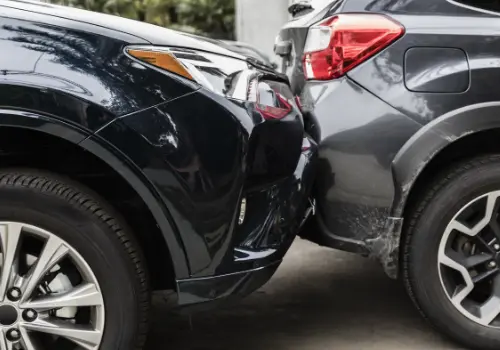
Even when all the rules are followed, a roundabout can be the scene of minor incidents. A small collision, hitting a kerb or central island, or damaging a wheel are all situations that can happen in a moment of distraction or as a result of another driver's unexpected manoeuvre.
For anyone driving a rental car, having the right protection can make a significant difference. Guerin offers different protection options for car rentals, allowing customers to choose the solutions that best suit their needs.
TOP Roadside Assistance can be particularly useful in the event of an unexpected incident on a roundabout. In situations covered by the service, it provides roadside assistance and towing without additional costs, according to the applicable terms and conditions.
The Collision Damage Waiver (CDW) can also limit the customer's financial responsibility for covered damage to the rental vehicle, subject to the applicable conditions and excess. On a roundabout, where minor collisions can occur, having the right protection can provide an additional layer of peace of mind.
There is another type of incident worth considering: damage caused by hitting kerbs or central islands. Tyres and wheels can be damaged even when there is no collision with another vehicle. In these cases, Guerin's Windscreen and Wheel Protection provides additional protection against covered damage to tyres, wheels, windscreens, mirrors, headlights and lights, subject to the applicable terms and conditions.
Are you driving a rental car in Portugal?
For a tourist who has just arrived in Portugal, or anyone driving in an unfamiliar city, a roundabout can become particularly challenging when you don't know which exit to take.
That's why Guerin recommends a simple rule: activate your GPS before entering an unfamiliar roundabout. Knowing the exit in advance allows you to prepare your route, reduce hesitation and lower the risk of choosing the wrong lane. Guerin's GPS can be a useful option for anyone who prefers additional navigation support during their journey.
It can also be useful to understand the basics of renting a car in Portugal, particularly if this is your first time using a car rental service in the country.
The rental process itself can also be simpler. Guerin pioneered a 100% digital car rental process, designed to make different stages of the rental experience faster and more convenient. Find out more about Guerin's 100% digital rental process.
The golden rule for driving around a roundabout
Driving around roundabouts in Portugal correctly comes down to a few essential principles: slow down, follow the signs and road markings, give way to vehicles already on the roundabout, choose the appropriate lane, indicate your manoeuvres and only change lanes when it is safe to do so.
And if you come across an unfamiliar roundabout, don't try to guess. Activate your GPS, anticipate your exit and stay calm.
If you're planning to rent a car in Portugal with Guerin, you can also choose the additional products and protections that best suit your journey and the level of cover you are looking for.
Because when it comes to roundabouts, arriving a few seconds later is always better than making a rushed decision.
Share