Guerin® Blog
Driving Advice
Car lights: when and how to use them correctly | Guerin
Share


With the arrival of autumn and winter, driving in Portugal requires extra care. There is more rain, fog, longer nights, mountain roads and situations where it is essential to know which car lights to use in each situation.
Car lights are not only there to light up the road. They are also a way of communicating with other drivers: they show your presence, indicate a change of direction, warn other drivers that you are braking, signal danger and help prevent risky situations.
Even so, there are still common questions: when should you switch on dipped headlights? When should you use full beams? Can rear fog lights remain on after the fog has disappeared? And what should you do if a bulb fails during a journey?
Whether you have just started driving in Portugal, are renting a car on holiday or are an expat getting used to Portuguese road rules, knowing the main car lights types is essential. It helps you drive more safely and avoid possible fines.
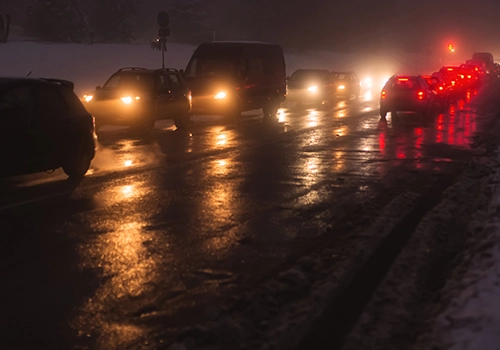
What car lights types are there and what are they used for?
Each vehicle light has a specific purpose. Some are used to illuminate the road, others to make the vehicle visible, while others communicate manoeuvres to other road users. Find out the rules.
Position lights (sidelights).
They should be white at the front and red at the rear and visible from 150 metres. They indicate the presence and width of the vehicle rather than illuminating the road.
When to use them: when stopping or parking, when the vehicle needs to be easily identified by other road users.
Dipped headlights (low beams).
They are white or yellow and emit a beam that illuminates the road for up to 30 metres. They should also be used whenever weather conditions reduce visibility.
When to use them: at night, in built-up areas, on illuminated roads, in tunnels, during heavy rain, on overcast days or whenever visibility is reduced.
Main-beam headlights (high beams).
They are designed to illuminate the road over a greater distance. They should illuminate the road for a distance of at least 100 metres and be used on roads without sufficient lighting when there is no risk of dazzling other road users.
They are useful on national roads, mountain roads or unlit roads, but should be used carefully. Whenever there is a risk of dazzling pedestrians, cyclists or other road users, switch to dipped headlights.
When to use them: on dark, unlit roads, provided there are no vehicles ahead or approaching from the opposite direction.
Fog lights.
They are used at the front and rear in fog, snow or heavy rain. The rear fog light is red and can dazzle other drivers, so it must be switched off as soon as conditions improve.
When to use them: only in heavy fog or when visibility is severely reduced. Switch them off as soon as visibility improves.
Direction indicators (turn signals).
Orange in colour, they tell other drivers that you are going to change direction, change lanes, overtake, enter or leave a roundabout, or stop at the side of the road.
Turn signals are not optional: they are the simplest way to communicate your next manoeuvre to other drivers. Using them too late, or not using them, increases the risk of sudden braking and accidents.
When to use them: whenever you are changing direction, changing lanes, overtaking, parking or driving through a roundabout.
Hazard warning lights.
They switch on all the turn signals at the same time. They are used to indicate that the vehicle represents a particular hazard to other drivers.
When to use them: in the event of a breakdown, accident, unexpected immobilisation, danger on the road or sudden braking in an emergency situation.
Brake and reversing lights.
Brake lights come on when you press the brake pedal, warning drivers behind you that you are slowing down or stopping. Reversing lights illuminate the area behind the vehicle and warn other drivers that the vehicle is about to reverse. They switch on automatically.
When to use them: they operate automatically, but you should check regularly that they are working. A faulty brake light reduces your visibility to vehicles travelling behind you.
What fines can I receive for using car lights incorrectly?
Driving with incorrect or faulty vehicle lights can be an offence under the Portuguese Highway Code and, above all, is a safety risk. Failing to use dipped headlights at night, in tunnels or in poor weather can result in fines ranging from €30 to €150.
Using full beams incorrectly and dazzling other drivers can also result in penalties ranging from €60 to €300. The same applies to using the rear fog light incorrectly when visibility is normal.
Driving with faults in the lighting system is also subject to specific rules. When the use of lights is mandatory, driving with faulty lighting signals is prohibited, except in situations provided for by law.
On motorways or roads reserved for cars and motorcycles, a fault with the vehicle's lights may require safety measures to be taken, including stopping the vehicle outside the carriageway, unless the minimum conditions are still met to continue to the nearest service area or exit.
In practice, if a bulb fails during your journey, you should assess the situation safely. If it is daytime and visibility is good, you may be able to drive to a garage or safe location. If it is night-time, raining, foggy or you are on a motorway, you should stop safely and request assistance.
Which car lights should I use in each situation?
The theory is simple, but what about in practice? Even experienced drivers can have questions in specific situations. Here are some practical examples to help you know which lights to use when driving.
In a built-up area at night:
Use dipped headlights. Even with street lighting, they help make the vehicle more visible to pedestrians, cyclists and other drivers. Avoid driving with only the sidelights and remember that using full beams in illuminated built-up areas is prohibited.
On a national road with little lighting:
Use full beams when there are no vehicles approaching from the opposite direction, no vehicles ahead, pedestrians or animals on the road. As soon as you approach another vehicle or are less than 100 metres from the vehicle in front, switch to dipped headlights.
In a tunnel, even during the day:
Always switch on your dipped headlights. In Portugal, using dipped headlights during the day is mandatory in tunnels signposted as such.
In heavy rain and fog:
Switch on your dipped headlights and use the front and rear fog lights if visibility is severely reduced. If the rain eases or the fog becomes light, switch off the rear fog lights immediately and keep only the dipped headlights on.
In light fog:
Use dipped headlights. If the fog is light and you can still see the road safely, it may not be necessary to switch on the fog lights.
In heavy fog:
Use dipped headlights and fog lights when visibility is severely limited. The rear fog light should be switched on when visibility for drivers behind you is very poor, but should be switched off as soon as the fog disappears or visibility improves.
On mountain roads in autumn and winter:
Use dipped headlights whenever natural light is insufficient. In unlit areas, you can use full beams, but only when there is no risk of dazzling other drivers.
When travelling through areas such as Serra da Estrela, Gerês, Marão or northern and central inland Portugal, pay extra attention to fog, rain, tight bends and sudden changes in visibility.
What are the most common car light mistakes made by drivers in Portugal?
Some mistakes continue to occur on Portuguese roads, even among experienced drivers. One of the most common is the excessive use of the rear fog light when there is no fog. Even light rain can lead some drivers to switch it on, strongly dazzling those behind them.
Another common mistake is driving with only the sidelights and forgetting to switch on the dipped headlights at dusk. Many drivers rely on daytime running lights (DRLs), forgetting that these do not activate the car's rear red lights, although in newer cars this is often managed automatically.
Finally, failing to switch off full beams in time when approaching another vehicle and failing to use indicators at roundabouts and when changing lanes are offences that violate the Portuguese Highway Code.
Driving in Portugal? Pay attention to the differences in car light rules.
If you are visiting Portugal or living here as an expat, it is important to understand some differences in car light rules. Although many European countries have similar regulations, some details may surprise drivers who are used to different legislation.
In Portugal, you must use lights from dusk until dawn and also during the day whenever visibility is insufficient, for example in fog, heavy rain, snow, dust or smoke. Dipped headlights are also mandatory during the day in signposted tunnels and on roads with reversible traffic.
For example, if you are from the UK, drivers are used to driving on the left-hand side of the road. When driving in Portugal, remember that you drive on the right and that vehicle light beams must be correctly adjusted to avoid dazzling other drivers.
For visitors from France, the main difference is understanding that heavy rain, fog and mountain roads may require more frequent use of lights due to the terrain and conditions in some parts of Portugal.
In the United States, rules vary from state to state. In many cases, headlights must be switched on when windscreen wipers are in use, but there is no single nationwide rule.
The practical rule in Portugal is simple: if visibility is reduced, use dipped headlights. If the fog is heavy, use fog lights, but switch them off as soon as they are no longer necessary.
How do you know which lights to use in a rental car in Portugal?
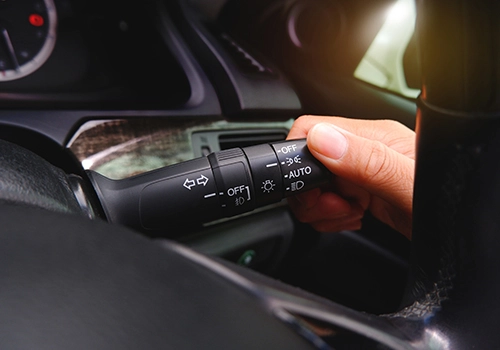
Light controls vary from one car brand to another. They may be located on the stalk next to the steering wheel, on a rotary switch to the left of the dashboard or on a fully digital panel.
Before setting off in a Guerin rental car, take a few minutes to familiarise yourself with the vehicle.
What should you check in the first few minutes in a Guerin rental car?
Before starting your journey, check the following:
- Locate the controls for dipped beams, full beams and sidelights.
- Check whether the car has an automatic lighting mode.
- Identify the front and rear fog light controls.
- Find out how to activate the hazard warning lights.
- Check where the full-beam symbol appears on the dashboard.
- Make sure all the lights are working correctly.
- Adjust the mirrors and driving position before setting off.
How can you check that your car lights are working correctly?
Before a long journey, especially in autumn and winter, carry out a quick check of the dipped beams, full beams, indicators, hazard warning lights, fog lights, brake lights and reversing lights.
If you are travelling with someone else, ask them to check the lights from outside the vehicle. If you are alone, you can use the reflection in a wall, shop window or garage door to check whether the lights are working.
You should also make sure the headlights are clean. Dirt, mud, splashes or dust can reduce lighting effectiveness, even when the bulbs are in good condition.
If a bulb fails during your rental, contact the Guerin assistance line. Driving with faulty lights can be an offence in Portugal and, in certain circumstances, may prevent you from continuing your journey safely.
How does Guerin protect your autumn and winter journeys?
To help your journeys run smoothly, even on the darkest nights in the Portuguese mountains, Guerin offers additional products designed to enhance your safety:
- Premium Road Assistance: if a bulb fails during a journey, especially at night, you may be unable to continue driving legally, depending on the situation and visibility conditions. This service provides fast and effective support in this and other situations that may immobilise the vehicle.
- Damage Protection with Reduced Excess: driving in reduced visibility increases the risk of an accident. In the event of an accident, this cover helps reduce the financial impact on the driver.
- Additional Driver: driving on dark roads requires extra attention. Sharing the driving on night-time journeys reduces fatigue and helps keep both drivers alert.
Ready to drive with the right lights?
Use dipped headlights whenever visibility is insufficient and save full beams for dark roads without nearby traffic. Above all, remember: the right light at the right time helps you see better and be seen sooner.
At Guerin, choosing the ideal model from our fleet and completing your 100% online booking takes less than 3 minutes. Before setting off, check the controls, test the lights and prepare for your journey. Then all that is left is to drive safely on an autumn getaway or winter getaway.

Share